Wednesday, May 11, 2011

Fredric Jameson / postmodernism: depthlessness


Fredric Jameson - Postmodernism or the Cultural Logic of Late Capitalism - summary 
part 1 - 2 - 3 - 4 - 5 - Review

The first characteristic of postmodernism defined by Fredric Jameson in "Postmodernism or the Cultural Logic of Late Capitalism" is that of depthlessness. A modern painting, Jameson suggests, invites interpretation, a hermeneutic development and completion of the world which is beyond what is represented. In a postmodern work, to put in simply, what you see is what you get, and no hermeneutic relations will be developed with the representation. This depthlessness is seen by Jameson as a new kind of superficiality.

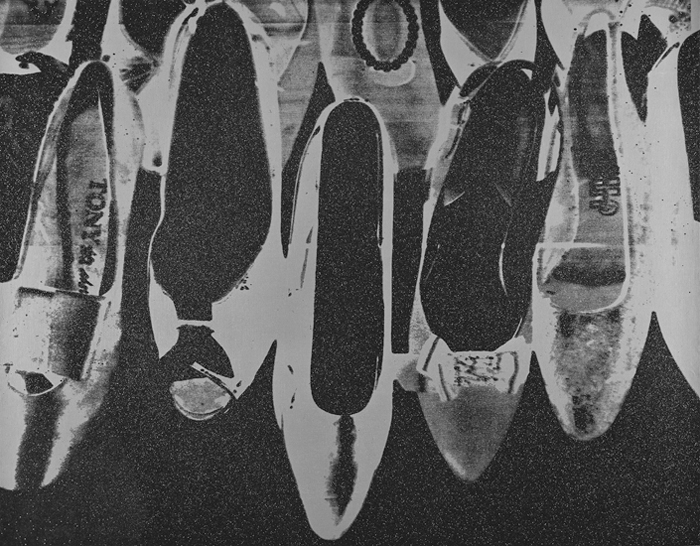
Jameson illustrates his point of depthlessness by two thematically related works: Van Gogh's "A Pair of Shoes" which represents high modernism and Andy Warhol's "Diamond Dust Shoes" which are obviously postmodern.

Jameson quotes Heidegger's interpretation of Van Gogh's works as one which invites the reconstruction of a whole peasant world and dire life and offers another possible interpretation of his own which follows the basic notion of addressing something which is beyond the actual shoes in the painting.

In contrast, "Diamond dust shoes" do not "speak to us", as Jameson puts it. Different associations are possible when looking at a Warhol's work, but they are not compelled by it nor are they necessarily required by it. Nothing in the postmodern work allows a lead into a hermeneutic step.  

Warhol's work is therefore an example of postmodern depthlessness because we cannot find anything which stands behind the actual image. Warhol is of course famous for stressing the commercialization of culture and the fetishism of commodities of late capitalism, but the stress in not positive or negative or anything at all, it just is. The depthlessness of cultural products raises the question of the possibility of critical or political art in late capitalism, especially when Jameson argues that aesthetic production today has turned into a part of the general production of commodities, an assertion which will be addressed later on.


Fredric Jameson - Postmodernism or the Cultural Logic of Late Capitalism - summary 
part 1 - 2 - 3 - 4 - 5 - Review


Tuesday, May 10, 2011

Heidegger's "place, space and building": the bridge and Black Forest farm

Heidegger: Building Dwelling Thinking - summary part 1 - 2 - 3

According to Martin Heidegger in "Building Dwelling Thinking" the relation between man and space takes on the form of dwelling. A building is what allows for a sense of place in which dwelling occurs. A bridge stretched across a river, Heidegger argues, provides such a sense of space. Out of numerous possibilities along the river, the construction of a bridge was the site in which a place was constituted. For Heidegger the bridge in not just a functional object, nor is it a dual signifier of referential object and symbolic meaning. For Heidegger, a bridge is a manifestation of the fourfold which is at the base of all dwelling. A bridge collects and unites all aspects of the fourfold, earth, sky, mortals and divinities into a "thing". Such things are distinguishes form one another by the manner in which the manifest the unity of the fourfold. A bridge, in other words, allows for dwelling on account of its predetermined unification of the fourfold.

Space is therefore something which stems out of a place. The fourfold of existence can only appear in the space created by a certain place, and the place, in the case of the bridge, was created only upon it construction. Actual geometric space is only a subsequent object of human contemplation. Therefore Heidegger distinguishes physical space from place. The bridge, as a place, constitutes its own part (and whole) of the world. Space, in a sense, is something which is created before it is experienced.

Heidegger sums up "Building Dwelling Thinking" by another example of a place of dwelling: the Black Forest farm house. The example of the Black Forest farm serves to illustrate how, for Heidegger, dwelling should be carried out.

Dwelling, to simplify matters, is something like "making yourself at home". Building is a form of dwelling, and dwelling is a form of thinking. The example of the Black Forest farm shows how building allows foe dwelling which is having a sense of place. Heidegger describes the Black Forest house and illustrates how it manifests the four part of the fourfold.

Heidegger: Building Dwelling Thinking - summary part 1 - 2 - 3


Heidegger's concept of "fourfold" in "Building Dwelling Thinking"

Heidegger: Building Dwelling Thinking - summary part 1 - 2 - 3

In his "Building Dwelling Thinking"  (in: "Poetry, Language, Thought") Martin Heidegger relates to his key concept of "fourfold" as a central aspect of dwelling (see previous part of the summary). The four elements of the fourfold are earth and sky, divinities and mortals.  The fourfold is a kind of fullness which is a part of dwelling. This unity of the fourfold cannot be divided into its components and each one of these can only be what it is only when the others are kept in mind. Therefore, Heidegger claims, a man is not only a being in the world, but a part of the fourfold of earth, sky, divinities and mortals.

Earth
Earth is the supporting ground on which we stride. It supports us in the most physical sense and also by nurturing, watering and providing for us. Despite its perceived stability, the earth as part of the fourfold is an elusive element.

Sky
 The sky as part of Heidegger's fourfold as the sky in their usual referential meaning but they have some additional layers of meaning. Human beings' gaze towards the sky gives birth the metaphors that reflect the fact that we are always both here but also "beyond". Therefore "sky" as a part of the fourfold are a spiritual component relating to eternity.

Mortals
The mortals in Heidegger's fourfold are human beings. Relating to mankind as mortals emphasizes our finiteness and instability of our existence. Only through "memto mori", the remembering of our inevitable death, can we come to terms with our essential nature.  By this we can sustain a proper dwelling which leads, according to Heidegger, to a "good death" as human beings which in not nothingness but rather our essential nature.

Divinities
Following Holderlin, Heidegger understands the divinities as the most basic criterion of mankind. God for Heidegger is a poetic fiction, an anonymous creator and provider. And it is through his anonymity that god sets the standards for dwelling in the world, by his concealed presence in everything that surrounds us.
Heidegger's fourfold is the unity of earth, sky, mortals and divinities. It is part of our being in space and the site in which dwelling takes place. Human beings provide access to the fourfold by being a part of it and by their dwelling, sustaining the fourfold and its unity.

In this fourfold unity humans exist in their dwelling which is "done right" by "sparing the earth" and maintaining its true nature without exploiting it. Dwelling according the Heidegger is accepting the sky as sky, with their blessing and atrocities. Dwelling is also constituted by "awaiting the divinities as divinities" and by recognizing our limited existence.


Heidegger: Building Dwelling Thinking - summary part 1 - 2 - 3


Martin Heidegger – Building Dwelling Thinking – article summary and review

Heidegger: Building Dwelling Thinking - summary part 1 - 2 - 3

Martin Heidegger's "Building Dwelling Thinking" (in: "Poetry, Language, Thought") opens with an argument that seems rather obvious, that a structure is essentially designed for man's dwelling. But he soon raises some considerations that undermine the simplicity of this statement. In fact, Heidegger argues, not all buildings are designed for dwelling, which is also obvious when we consider factories, office buildings etc. this is the initial framework for Heidegger's "building dwelling thinking" which looks into the relation between dwelling and building and asks what it means to dwell, how does building relate to dwelling and does building in itself allows for dwelling.

Heidegger asserts that the modern world ('building dwelling thinking" was written in the wake of the housing shortage after ww2) has brought about a negative severance between building and dwelling. He looks at the origins of the German word "bauen" – "to build" and claims that it has lost its original meaning of "being" in a certain place. Heidegger then proceeds to argue that the manner in which we dwell is the manner in which we are, we exist, on the face of the earth – an extension of our identity, of who we are.

Since dwelling relates to the manner in which we exist, our "being in the world", Heidegger holds that problems of building are essentially problems of dwelling. Building is, in fact, dwelling, and with dwelling being the manner in which human beings exist on earth building as dwelling is something which nurtures things, natural or man-made.

Heidegger proceeds to argue that modern times have brought about confusion in the understanding of relations between building and dwelling with building not conceived as related to the state of our existence in the world. Building, in other words, in not a mere problem of providing shelter or housing. Building as dwelling is not just a functional need for a building, in this respect, does not only make apparent but also constitutes a part of the tradition that it endows. It is built as a part of a community and enables this community to experience a mutual sense of the present, forged by a known historical past and a predicted future.

Dwelling according to Heidegger is to remain in place and to be situated in a certain relationship with existence, a relationship which is characterized by nurturing, enabling the world to as it is. And in Heidegger's own words: "the basic character of dwelling is to spare, to preserve… dwelling itself is always a staying with things. Dwelling, as preserving, keeps the fourfold in that with which mortals stay: in things" (Heidegger – "Building Dwelling Thinking" pp.150-151).

Heidegger: Building Dwelling Thinking - summary part 1 - 2 - 3

Saturday, May 7, 2011

Thoughts on "Deep play: Notes on the Balinese Cockfight" by Clifford Geertz

Clifford Geertz's "Deep play: Notes on the Balinese Cockfight" is one of the most insightful and important programmatic articles in anthropology as well as sociology and cultural studies. The analysis of the Balinese cockfight, as interesting as it is, serves only to demonstrate the principle of Geertz's approach which is that cultural products, in this case a form of ritual, can serve as texts which can be read a deciphered. The basic assumption here is that cultures and societies form an image of themselves in their conducts, habits, cultural practices and customs. Geertz's approach is in a sense a functionalistic one in arguing that social structures, beliefs, tensions, hopes, fears and many more are invested and manifested in such cultural forms, which are the manner in which a culture relates itself to itself.

One of the direct implications of Geertz's "Deep play: Notes on the Balinese Cockfight" is in fact was Pierre Bourdieu says argues for in "High Fashion and High Culture", namely that what is considered to be "unworthy" subjects can serve high scientific purpose if researched with the right attitude.

When reading "Deep play: Notes on the Balinese Cockfight" it is highly tempting to compare the Balinese cockfight with western sports. Just think about how people oppose each other over local or high school leagues only to unite when the city's team plays another city and then unite with the former opponents when it comes to international matches.

But it's not only sports. Geertz's (and Bourdieu's) notion of cultural texts can be applied to just about anything. Commercials for instance are very insightful when read as cultural products. Commercials are highly adapted to "speak" to a certain culture, to its needs, beliefs, fears, whishes and so on and so on. In that sense, a commercial as somewhat of a mirror image of culture, a reflection of it which can prove to be most insightful when not thinking "oh! I want that…" but rather considering it as a subject for investigation.

Might interest you:


Norbert Elias- "The Genesis of Sport as a Sociological Problem" – article summary

In "The Genesis of Sport as a Sociological Problem" sociologist Norbert Elias offers a socio-historical approach for analyzing the formation of modern sports by focusing on the change in degree of tolerated violence through the process of civilization.

This civilization process according the Elias is one in which man repressed his bodily and emotional urges and learned to be more minded of other people with prohibitions becoming a part of the modern self, and restrictions becoming something natural.

This process is a spontaneous product of changing social formations.  Modern societies are characterized by state monopoly over the use of violence. Elias wonders how it came to be that what is now considered as "sports" originated in 19th century England. He claims that the widespread circulation of English forms of sports is due to their compatibility with certain needs regarding leisure activities which have evolved in modern times.

 Elias shows this by refuting the assumption that modern sport is a direct successor of ancient classical sport played in ancient Greece. Ancient sporting activities, according to Elias, had very different characteristics and they evolved in very different settings. One of the central characteristics is the level and nature of permitted violence. In ancient times activities such as wrestling and boxing allowed for a much higher degree of violence than modern versions do. Traditional rules of the game were unwritten and flexible in their application, unlike today when rules are highly regulative, specified and debatable. For instance, unlike today, fights were not limited in time and lasted until one of the participants surrendered or was unable to keep fighting. The level of violence in ancient Greek sports was symptomatic of certain characteristics of that society, which for starters placed the rule of controlling violence in private rather than national hands.

The ethos of ancient sports was also different. Fighting in ancient Greece related to the fighting ethos of the warrior aristocracy rather than the professional athlete ethos of present times. The most important thing for a fighter back then was to keep on fighting, with victory or defeat in the hands of the gods and surrender being considered shameful. This ethos was also manifested in the importance of physical appearance which ties sport, war and the aesthetics of classical times. In addition, the moment of victory was the climax of ancient sport activities, while in modern time it's the participation and excitement (enhanced by gambling) which are important, and this explains why fairness and equal chances are so important.


Thursday, May 5, 2011

Susan Sontag – On Photography – summary

Throughout history reality has been related through images and philosophers such as Plato have made efforts to diminish our reliance on representations by pointing at a direct ways to grasp the real. Susan Sontag quotes Feuerbach in saying that our age prefers the photograph to the real thing, the appearance before experience. This argument, Sontag says, is widely accepted in modern culture which is constantly engaged with producing and consuming images to such a degree that photography has been made essential for the health of the economy and the stability of social structures.  
Photography, according to Susan Sontag, holds an almost unlimited authority in modern society. Such photographic images are capable of replacing reality by virtue of being not only a mirror or interpretation of in, but also a relic of reality, something that is taken straight from it.

Photography, unlike painting, does not only address and represent its object and does not only resemble it; it is also a part of the object, its direct extension.

Photography, according to Sontag, is a form of acquisition in a number of ways. When you photograph something, it becomes a part of certain knowledge system, adapted to schemas of classification and storage starting from family photographs up to police, political and scientific usage. Photography, in other words, is a form of supervision.

Primitive tribes are afraid that the camera will take their soul or something from their being. Modern societies do not of course share this fear by still views photography as directly related to the material world, a physical relic of it. our attitude towards photographs is still fetishistic, still voodoo like.
A typical nowadays statement is that an experience was "like in a movie", which is said when other forms of description fail to convey how real a sensation was. While many people in developing countries are still hesitant about being photographed, people in industrialized countries are more than happy to stand in front of a camera and that is because, Sontag argues, that being photographed gives us a sense of being real and of existing.

Photography is a means for capturing reality (which is considered unobtainable) by freezing it. You cannot hold reality but you can hold a photograph. photography in not only a way of preserving the past but also a way of handling the present., with photographic images becoming more and more widespread in modern times.

Photography also means that we can see something before we experience it, and that takes away from the virginity and openness of the way we experience reality. reality, in other words, is photographed before it is experienced.

Photography, Susan Sontag holds, is not a mere copy of reality but rather a recycled copy. We consume photographs at an ever increasing rate and they are therefore consumed and need to be replaced. Meaning, the more we take photographs the more we need to take photographs, and this accounts for what is known today as the "pictorial turn".

On Photography:

See also Roland Barthes On Photography

Books by Susan Sontag and about photography you should definitely read